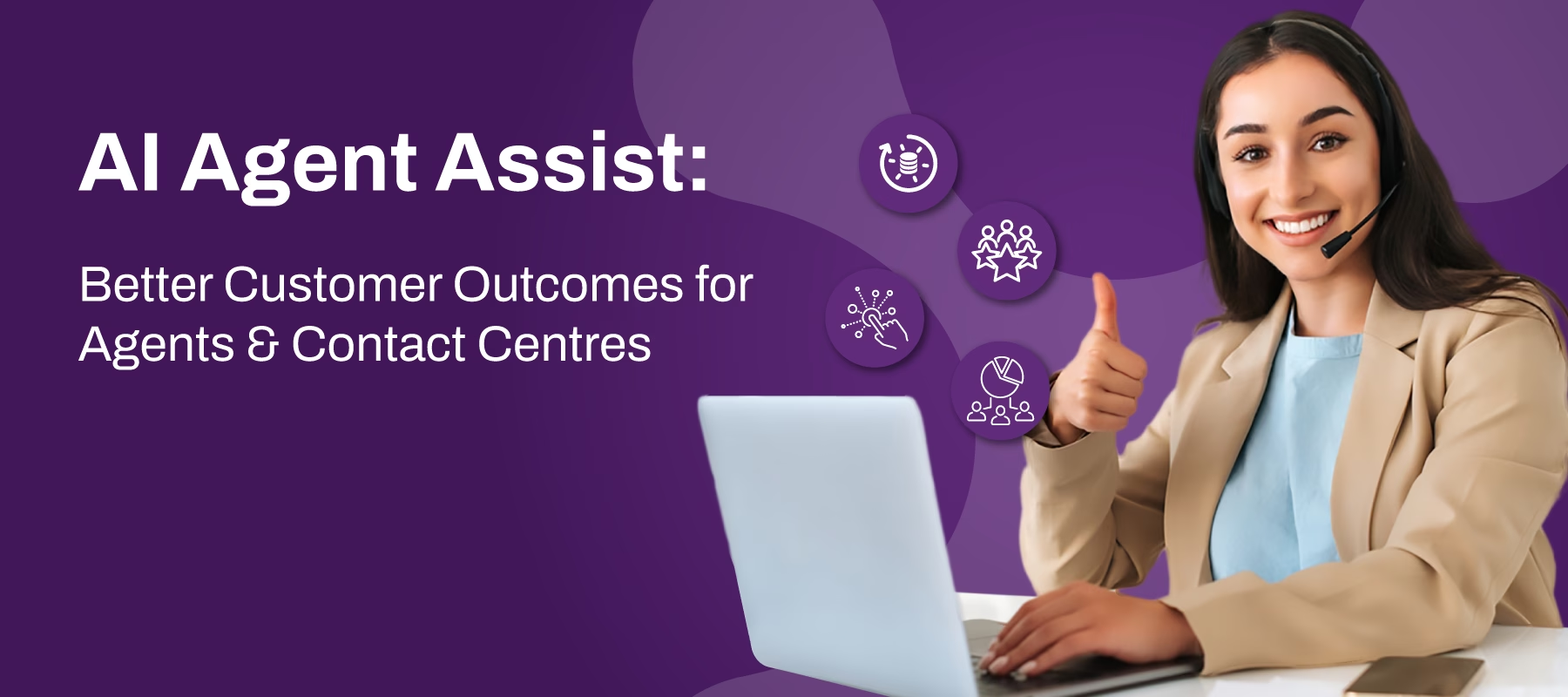




Summary: AI Agent Assist represents a significant advancement in customer service, harnessing artificial intelligence to support human agents. This article delves into the workings, features, and benefits of AI Agent Assist and explores how Exotel can help improve contact center performance.
Customer service has evolved dramatically with technological advancements. Businesses can now solve their customers’ issues swiftly and in a more personalized manner. Further, customer service professionals and agents have access to tools that allow them to collate all customer data in one place. They can then analyze such data and modify their responses based on the insights.
Artificial Intelligence (AI) has further amplified these benefits as it allows businesses to study a larger amount of data and employ advanced analytics techniques. AI Agent Assist, as the name suggests, refers to the use of such AI technologies to support agents. In recent years, these systems have become more prominent. In fact, a Hubspot survey found that 79% of customer service agents consider such AI tools as integral to their overall strategy.
Due to its growing popularity, it’s important to examine the technology in detail. This article strives to do the same. It explores answers to questions like what this technology actually does, how it works, and its top benefits.
What is AI Agent Assist?
AI Agent Assist or Virtual Assistant refers to the use of Artificial Intelligence technologies to support human customer service agents in real-time. These tools leverage LLM and data analytics to provide agents with immediate insights and recommendations.
It is important to note that these systems differ from fully automated ones. AI Virtual Assistants function as an augmentation and a collaborative partner. They enhance human capabilities rather than replace them.
How does it Work?
AI Agent Assist works by integrating with existing customer service platforms and analyzing ongoing conversations between agents and customers. Here’s a step-by-step overview:
»Integration: AI Agent Assist integrates with knowledge base, customer service platforms and communication channels.
»Data Analysis: Using LLM, the system analyzes text or voice interactions in real time.
»Recommendations: Generates insights and recommendations based on historical data, customer sentiment, and context.
»Agent Support: The AI provides agents with suggested responses and next-step actions for the integrated knowledge base.
»Continuous Learning: The system continually learns from interactions, improving its recommendations over time.
Features of AI Agent Assist
AI Agents and Virtual Assistants are constantly evolving and becoming more sophisticated. Currently, most AI Virtual Assistants employ the following techniques and are characterized by:
»Large Language Model (LLM): LLMs enable AI to understand natural language, allowing agents and customers to interact freely without relying on scripts.
»Sentiment Analysis: It is important to respond to customer queries in an empathetic manner. AI Assist technologies, therefore, use sentiment analysis to gauge the emotional tone of customer interactions. Agents can then tailor their responses according to the customer’s emotional state.
»Automated Workflows: AI Assist can automate routine tasks, such as ticket categorization and escalation. Customer service teams and agents can thus focus on more complex issues that require human intervention. This is important as 80% of consumers still prefer human interaction over AI for complicated matters.
»Omnichannel Support: The AI can operate across multiple communication channels, providing consistent support whether the interaction occurs via phone, email, chat, or social media. A true omnichannel contact centre platform ensures these channels share context so agents always have the full picture, regardless of where the conversation started.
»Contextual Understanding: The AI analyzes ongoing dialogue, customer history, and CRM data to understand the full context. This allows it to provide personalized suggestions, ensuring that responses are relevant and tailored to the individual customer.
Benefits of AI Agent Assist
According to Accenture, 75% of businesses plan to invest more in AI for customer service. The following points explain the reasons behind this trend:
»Reduced Agent Workload: Businesses can struggle with attracting and retaining the right agents in their customer service teams due to excessive workload. As AI can automate routine tasks, this workload can be significantly reduced. This reduces agent frustration, lowers staffing costs, and allows agents to focus on matters requiring human intervention.
»Improved Scalability: As a business grows, the number of customers also increases. To meet the needs of the growing customer base, the business needs to employ more agents. This can prove to be costly and time-consuming exercise. AI Virtual Assistants can solve this issue. The AI tools such as chatbots can handle the increased interaction volumes without compromising quality and cost-effectiveness.
»Faster Responses: AI tools can match customers with the most appropriate agent based on the specific nature of their query. Additionally, the selected agent receives standardized replies and recommended answers drawn from the knowledge base. The agent also gains access to the customer’s full profile and history, minimizing the need to ask repetitive questions. Platforms that include call monitoring alongside agent assist give supervisors visibility into whether faster responses also meet quality standards. This streamlined approach ensures that issues are resolved as quickly as possible.
»Data-driven Insights and Personalization: 46% customer service specialists believe that AI tools like chatbots can provide more personalized experience to customers. This becomes possible due to the centralized knowledge base and advanced analysis techniques. AI tools can analyze customer interactions from start to end, and customize the responses based on the insights.
»Reduced Human Errors: Human error is inevitable in customer service. Contact center AI systems can reduce such errors with the help of automated insights and recommendations. Moreover, AI enables agents to access the interactions of other high-performing agents. They can learn from such interactions and improve their skills over time. AI Agent Assist also provides ongoing performance feedback to agents. Pairing it with a conversation quality analysis tool makes it possible to automatically score every interaction, not just the sample a supervisor can manually review. In the long run, it translates to fewer errors and consistent responses.
What to Look for When Evaluating AI Agent Assist Software
The market for agent assist tools is crowded. Before requesting a demo, validate that any platform you are evaluating meets these four criteria:
1. Native integration with your existing channels.
A tool that only works with chat adds no value to a contact centre where voice is the primary channel. Look for platforms that cover voice, chat, and messaging from a single system. Exotel’s platform handles all three natively, which means agent assist recommendations appear regardless of whether the customer called in or messaged.
2. Real-time, not post-call.
Some tools analyse interactions after the call ends and surface insights in reporting dashboards. That is useful for coaching but is not agent assist. Genuine agent assist surfaces recommendations during the conversation, before the agent responds, not as a post-call debrief.
3. Sentiment detection with escalation triggers.
A basic sentiment indicator that turns red when a customer is frustrated is not enough. Look for platforms where negative sentiment automatically triggers a supervisor alert or live monitoring so that the right person can join the call before the situation escalates.
4. Closed-loop quality scoring.
Agent assist produces recommendations, but you need to measure whether agents are following them and whether doing so improves outcomes. A conversation quality analysis layer that automatically scores every interaction closes this loop and gives you data to coach from, not guesswork.
Improve Your Contact Center Performance with Exotel
Now that you’ve grasped the fundamentals of AI Agent Assist, the next logical step is to choose an AI-powered contact center solution. Exotel stands out as an exceptional choice, offering a full-stack, AI-driven platform that can be easily integrated with your existing customer service systems.
Our cutting-edge AI architecture includes Gen AI-powered voice and chatbots, a conversation quality analysis tool, transcription and summarisation tools, and more. These advanced tools empower you and your agents to:
»Understand and replicate human conversation nuances, including emotionally intelligent comprehension and multi-language support.
»Benefit from advanced audio processing and noise cancellation to maintain clear and uninterrupted customer interactions.
»Leverage our platform’s horizontal scalability to ensure constant availability and resilient service, no matter the demand.
»Tailor communications to different business functions and personalize user experiences.
»Consolidate information from diverse sources to arm human agents with comprehensive knowledge.
»Automatically score conversations with AI and enable targeted interventions to boost agent productivity.
Thus, Exotel’s comprehensive suite of tools can enhance contact center performance and provide your agents with the real-time support they need to deliver superior customer service. Experience the transformative power of Exotel’s AI-powered contact center and take your customer satisfaction to new heights.
FAQs
1. What is the difference between AI agent assist and a chatbot?
A chatbot handles customer queries autonomously, without a human agent in the conversation. AI agent assist works alongside a human agent during a live interaction, surfacing recommendations, knowledge base articles, and sentiment signals in real time. The agent remains in control of the conversation; the AI supports the response rather than generating it independently.
2. Does AI agent assist replace human agents?
No. AI agent assist is designed to augment human agents, not replace them. It handles the information-retrieval and recommendation work so that agents can focus on listening to the customer, building rapport, and making judgement calls. For fully automated handling of routine queries, a separate tool such as a voicebot or chatbot is more appropriate.
3. Which contact centre channels does AI agent assist support?
This depends on the platform. Most agent assist tools support live chat and email. Fewer support voice calls in real time, which requires speech-to-text transcription running during the call. Exotel’s platform covers voice, chat, and messaging from a single system, so agent assist recommendations are available regardless of channel. See Exotel’s omnichannel contact centre for details.
4. How do you measure the ROI of AI agent assist?
The most direct metrics are average handle time (AHT), first-contact resolution (FCR), and agent error rate. A reduction in AHT of 15 to 30 seconds per interaction compounds quickly at scale. FCR improvement indicates that agents are resolving queries correctly on the first attempt rather than creating repeat contacts. Pair agent assist with a conversation quality analysis tool to get automated scores on every interaction, which makes the before-and-after comparison straightforward.
5. How long does it take to deploy AI agent assist?
A basic deployment with knowledge base integration and suggested-response functionality can go live in two to four weeks. A full deployment covering sentiment analysis, automated escalation triggers, quality scoring, and CRM integration typically takes six to ten weeks, including agent training and calibration. The calibration period, where the model learns from your actual interaction data, is the most important part of the timeline and should not be compressed.
6. Does AI agent assist work for voice calls or only chat?
It works for both when the platform includes a real-time speech-to-text layer. Without that layer, agent assist is limited to text-based channels. Exotel converts spoken conversation to text in real time, which means the agent assist engine can surface recommendations during a voice call in the same way it does during a chat. If voice is your primary channel, confirm that any platform you evaluate includes this capability before committing. See how Exotel’s Voice AI Agent handles real-time voice processing.